Mystery about the Universe’s 1st Black Holes May Be Solved at Last...
A Mystery about the Universe’s First Black Holes May Be Solved at Last
Astrophysicist Priyamvada Natarajan has foreseen a groundbreaking concept: black holes can emerge independently, without the reliance on stars. Recent observations have lent credence to her hypothesis, marking a significant stride forward in our understanding of the universe.
https://www.highcpmgate.com/x5qev1y9b3?key=9a2ec218189710fa948b955823bafb56

This picture showcases the most remote black hole ever identified in X-rays, potentially shedding light on the genesis of some of the earliest supermassive black holes in the cosmos. Situated within the galaxy UHZ1, the exceedingly distant black hole was captured by NASA’s Chandra X-ray Observatory (depicted in purple) and complemented with infrared data from NASA’s James Webb Space Telescope (shown in red, green, and blue). Credits: X-ray - NASA/CXC/SAO/Ákos Bogdán; Infrared - NASA/ESA/CSA/STScI; Image Processing - NASA/CXC/SAO/L. Frattare & K. Arcand

As astronomers delve into the earliest epochs of the universe, they've stumbled upon a trove of massive black holes that appear to have matured far quicker than previously thought possible.
Priyamvada Natarajan assumes the role of a cosmic biologist, delving into the life cycles of these precocious black holes—objects so dense that they ensnare all matter and light within their grasp. Beginning her journey as an astronomy graduate student, Natarajan was among the pioneers who approached black holes not merely as solitary entities but as populations, akin to studying the general taxonomy and evolution of bats in a rainforest. Now, as an astrophysicist at Yale University, she persists in unraveling the mysteries surrounding these celestial entities, with a newfound focus on their origins.
Conventionally, black holes emerge in the aftermath of colossal stellar explosions, gradually accumulating mass as they feed on nearby gas reservoirs. However, a few observations of supermassive black holes in the universe's infancy have hinted at a more complex narrative. In 2006, Natarajan and her colleagues proposed a radical hypothesis suggesting that gas disks could collapse directly into unusually massive infant black holes without undergoing the conventional star formation process. Last year, a collaborative observation involving the James Webb Space Telescope (JWST) and the Chandra X-ray Observatory identified a distant, luminous black hole, seemingly validating Natarajan's conjecture.
Raffaella Schneider, an astrophysicist at Sapienza University of Rome, remarks, "It's undeniably a compelling argument in favor of these hefty black hole seeds. Natarajan's proposition has significantly broadened the community's perspective on the diverse pathways black holes can take."
Natarajan discusses with Scientific American how recent observations bolster her theory of "direct-collapse black holes" and what they unveil about the lineage of these enigmatic entities.
[The following is an edited transcript of the interview.]
What sparked your interest in researching black holes and their origins?
I've always been drawn to the invisible constituents of the universe. My work primarily revolves around grasping, on a fundamental level, the nature of these enigmatic components—dark matter, dark energy, and black holes. These entities possess an irresistible allure, serving as reminders of the boundaries of our understanding, the frontiers where familiar laws of physics falter.
Over the past decades, black holes have transitioned from abstract mathematical concepts to tangible entities we can observe, now occupying a central role in our comprehension of galactic evolution. The cosmos is brimming with black holes of varying sizes, constituting a vital component of our cosmic inventory. Hence, understanding their origins stands as a quintessential unresolved puzzle.
What aspects of black hole formation remain elusive to us?
Traditionally, black holes arise from the demise of stars. When the most massive stars succumb to gravitational collapse, they leave behind a compact remnant—a black hole. This narrative of stellar evolution is relatively well-established.
But around two decades ago, as we started to look farther and farther back into the universe with missions such as the Sloan Digital Sky Survey, we found a handful of very massive black holes —up to around a billion times the mass of the sun—when the universe was just one to two billion years old. Given the rate at which we know black holes like to feed, there just wasn’t enough time to take the tiny seeds you’d get from the first stars exploding and grow them to these behemoth black holes. Over the next few years, we started to see that these weren’t just a few freak objects; there was actually an entire population of supermassive black holes in the very early universe. And that’s when the conundrum began.
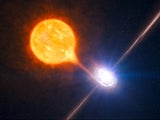
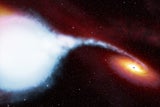
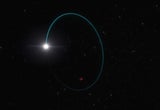
Some people began exploring whether there might be ways for black holes to feed much faster than the known limit. Theoretically there are, but we have yet to see convincing observational indications of this. So I started wondering, what if we just started with larger seeds? My team and I realized that if a gas disk is radiated by stars from a nearby galaxy, it could circumvent the star-formation process and collapse directly into a black hole. This direct-collapse black hole would be much larger at birth—1,000 to 100,000 times the mass of the sun. That black hole could then merge with a nearby galaxy and easily grow to the size we see.
How was this proposal received by the community?
We had a lot of people pushing back. They said, “The physics is cute, and it makes sense, but is this process efficient enough to actually happen in the universe?” At the time, these epochs of the universe were not accessible observationally. To watch these initial seeds being formed, we needed to look back to the first billion years after the universe’s formation.
That’s why the promise of JWST was so tantalizing; it kept us motivated to keep working on this. We began thinking about what signs we could look for as evidence of direct-collapse black holes, and we came up with an idea. In nearby galaxies, the mass of all the stars is often 1,000 to 10,000 times the mass of the central black hole. But in these direct-collapse scenarios, for a brief period of time, the mass of the black hole could actually be comparable to the mass of the stars. This means you should see an extremely bright, actively feeding black hole that essentially outshines all the stars in the galaxy. If we could view one of these galaxies in both x-ray and infrared light, we would see distinct signatures of the overmassive black hole in its center.
Even with JWST and Chandra, however, we can’t see far enough back to directly witness early black hole seeds being formed. But I realized that if nature were kind to us, one of these galaxies could be hiding behind a magnifying glass: a galaxy cluster rich in dark matter that acts as a dramatic gravitational lens. I had been working to map some of these gravitational lenses with the Hubble Space Telescope, and I suggested we focus our new telescopes on this very complex cluster called Abell 2744. I knew every part of that dark matter map inside and out. I was hopeful, but this was a real shot in the dark.
And how did it pay off?
Lo and behold, early last year I got a call from my colleague, astrophysicist Akos Bogdan, who had seen the Chandra observations of galaxies behind the Abell 2744 lens. He said, “Are you sitting down? I think we found something.” By complete coincidence, the spectrum from one galaxy matched unbelievably well with the prediction plots we made in 2017 of a hypothetical detection. It was gobsmacking. It checks off every predicted property. It’s very compelling evidence that direct-collapse black holes do form in the early universe. This is no longer just a speculation.
Now, there could still be other ways to form black hole seeds. That’s what I’m moving onto next: trying to uncover other pathways and what their unique observational signatures could be. It opens a whole Pandora’s box of exciting questions.
I can imagine. How did it feel to finally find evidence for your idea in nature?
This is exactly what I find so thrilling about being an astrophysicist—I want theoretical ideas to be confronted with observational data. We are in this amazing time in history where you can make a prediction and within your lifetime it can be validated or invalidated. It’s precisely why people say we’re living in the golden age of cosmology. I am deeply grateful.
https://www.highcpmgate.com/x5qev1y9b3?key=9a2ec218189710fa948b955823bafb56
Tahmid hasan
Comments
Post a Comment